When people talk about business performance, turnover is almost always the first figure mentioned. Annual reports open with it, newspapers use it to compare companies, and entrepreneurs often describe their own success by referring to how much they sell each year. It is easy to understand why. Turnover is simple, immediate and apparently objective. It provides a single number that seems capable of summarising the performance of an entire business.
The problem is that turnover is also one of the easiest figures to misinterpret.
A company can double its sales while becoming less profitable, less efficient and financially weaker. Another business may report almost identical turnover for several consecutive years while steadily improving its margins, strengthening its market position and generating increasing amounts of cash. Looking only at revenue, both businesses appear to tell a similar story. In reality, they may be moving in opposite directions.
This misunderstanding often leads managers to celebrate the wrong achievements and ignore the warning signs that deserve attention. Higher sales are generally positive, but they are never the objective in themselves. Every business exists to generate value for its owners and customers in a sustainable way. Turnover is simply one of the consequences of how well the organisation performs across dozens of different activities.
It is therefore more accurate to think of turnover as the final score rather than the match itself. The score tells us who won, but it does not explain why. To understand that, we need to analyse everything that happened during the game.
Understanding those underlying factors is where management begins.
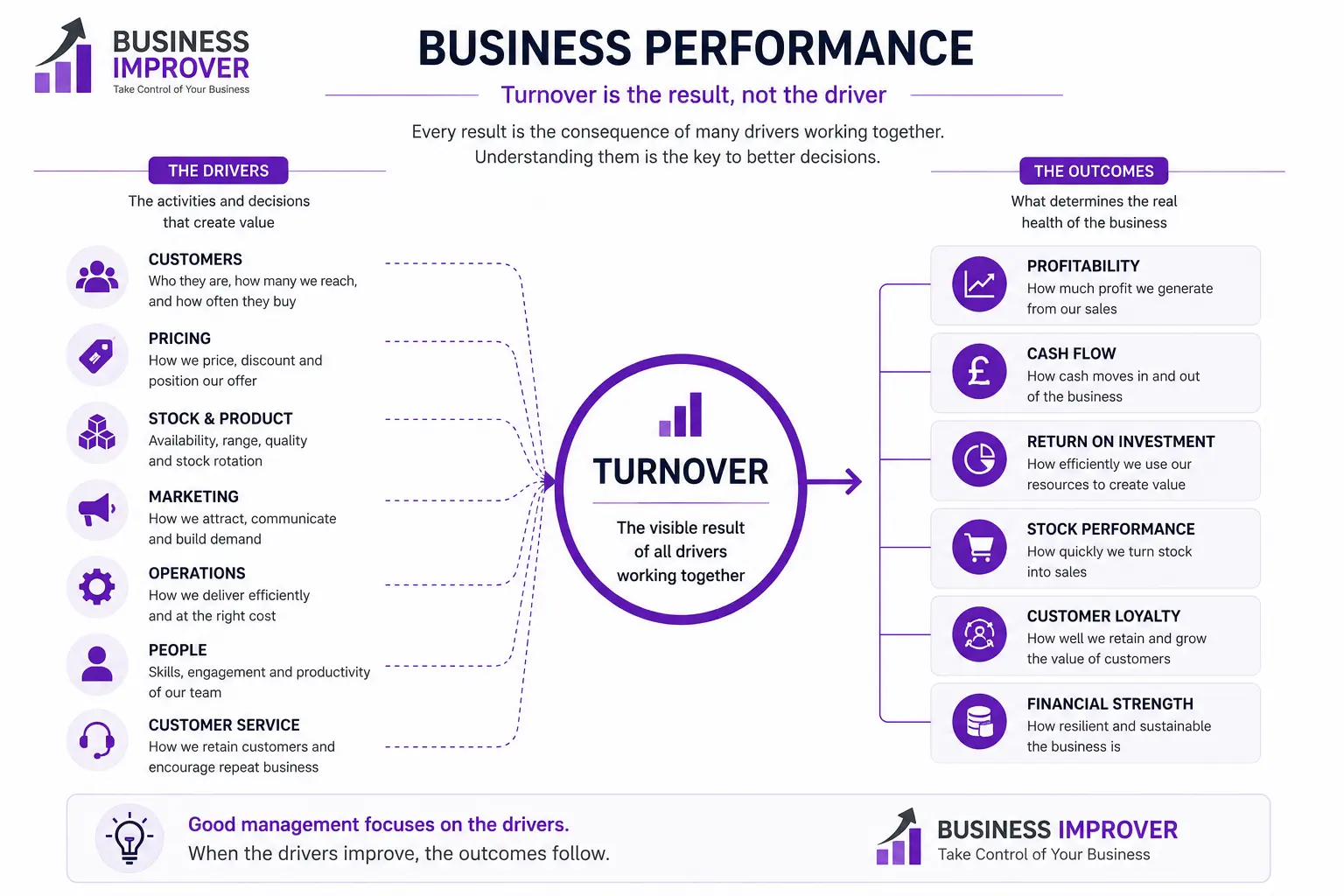
Turnover Is an Outcome, Not an Explanation
One of the most common mistakes in business is confusing outcomes with causes.
Turnover belongs to the first category. It tells us what happened during a given period, but it cannot explain what generated that result. Every pound of revenue is the consequence of hundreds, sometimes thousands, of decisions made across the organisation. Purchasing, pricing, marketing, customer service, operations, product availability, staff performance and financial management all contribute to producing that final number.
Looking only at turnover is therefore similar to looking at the final balance of a bank account without understanding the transactions that created it. The balance itself is important, but it only becomes meaningful when we know where the money came from and how it was spent.
The same principle applies to business performance.
Two retailers may each report annual sales of £20 million. One achieves those sales while maintaining healthy margins, excellent stock rotation and strong customer loyalty. The other reaches exactly the same turnover by relying on continuous promotions, carrying excessive inventory and accepting shrinking profitability. From the outside, both companies appear equally successful because the headline figure is identical. Internally, however, they are fundamentally different businesses.
Experienced managers rarely stop at the first number they see. Instead, they immediately ask what has produced it. They understand that turnover is not the business itself but simply the visible consequence of a much larger system working behind the scenes.
This distinction is subtle but extremely important because it completely changes the way decisions are made. Managers who focus exclusively on turnover often react to results after they appear. Managers who understand the drivers behind turnover are able to influence those results before they occur.
That difference separates reporting from management.
Growth Does Not Always Mean Improvement
One of the assumptions most deeply rooted in business is that growth automatically represents progress. It seems logical. Selling more products or services should mean that the company is becoming stronger.
In practice, the relationship is far more complex.
Growth introduces complexity. More customers require more stock, more logistics, more administration, more customer support and often more employees. Each additional sale creates operational consequences that extend well beyond the invoice itself. If these processes are not improved at the same pace as revenue, the organisation gradually becomes less efficient even while turnover continues to increase.
This is why periods of rapid growth often expose weaknesses that remained hidden when the business was smaller.
Warehouses become overcrowded because purchasing decisions have not evolved. Customer service struggles to respond quickly enough because staffing has not kept pace with demand. Cash flow becomes tighter because larger inventories absorb increasing amounts of working capital. Operating costs rise faster than expected, slowly reducing profitability despite higher sales.
The management team continues celebrating record turnover while failing to notice that the quality of the business is gradually deteriorating.
Many companies discover these problems only when they become impossible to ignore. Profit starts falling despite increasing sales. Cash becomes difficult to manage. Investment plans are postponed because liquidity is under pressure. Managers suddenly begin searching for explanations, even though the warning signs had been present for months.
The problem was never a lack of data. It was assuming that turnover alone represented success.
This is precisely why performance should never be evaluated through a single indicator. Businesses are complex systems, and every system can only be understood by observing how its different components interact with one another. This is one of the principles behind KPIs: The Cardinal Points to Drive Your Business, where we explore how operational indicators help managers understand the drivers behind business performance rather than simply observing the final results.
Numbers Only Become Meaningful When They Are Placed in Context
Every number tells a story, but only after it has been placed in the right context.
An increase in turnover, taken on its own, is neither good nor bad. Its meaning depends entirely on the environment in which the business operates.
A company that increases sales by five per cent may appear to have performed well until inflation reaches seven per cent. In real terms, the business has actually become smaller. The same figure may also look very different if competitors have grown by fifteen per cent or if the entire market has contracted. Identical numbers can describe excellent management, average performance or a worrying decline depending on the circumstances surrounding them.
This is one of the reasons experienced managers spend as much time comparing figures as they do collecting them.
Historical performance provides only one reference point. External benchmarks are equally important. Market trends, consumer behaviour, competitive positioning and economic conditions all influence the interpretation of internal results. Without this wider perspective, management risks rewarding decisions that simply followed favourable market conditions while overlooking improvements achieved in much more difficult circumstances.
Context also changes the interpretation of individual KPIs.
A reduction in stock levels, for example, may indicate healthier inventory management. Equally, it may reveal purchasing problems that will soon create stock shortages. A higher average transaction value may reflect successful upselling, or it may simply be the consequence of inflation. Even increasing profit deserves careful interpretation. If profitability has improved because essential investments were postponed, the result may prove damaging in the longer term.
Numbers never exist in isolation. They influence one another continuously, and they are influenced by the environment in which the business operates.
For this reason, analysing a company should resemble assembling a puzzle rather than reading a scoreboard. Every figure contributes one piece of information, but no single piece is capable of revealing the complete picture.
Only when those pieces begin fitting together does management become something more than reporting.
KPIs Explain the Story Behind the Numbers
Turnover is often described as the heartbeat of a business, but a heartbeat alone does not tell a doctor why a patient is healthy or unwell. It simply confirms that something is happening. To understand the condition of the patient, a doctor needs to examine many other indicators and, more importantly, understand how they relate to one another. Business works in exactly the same way.
This is where Key Performance Indicators become indispensable. Their purpose is not to replace turnover but to explain it.
Every industry has its own operational drivers, yet the principle remains remarkably consistent. A retailer may analyse customer traffic, conversion rate, average transaction value and stock turnover. A manufacturer may focus on production efficiency, waste, delivery performance and capacity utilisation. A consultancy may monitor billable hours, project profitability and client retention. The indicators themselves change from one business to another, but they all perform the same function: they reveal the mechanisms that produce the final financial results.
The important point is that KPIs should never be considered individually. They form a system in which every element influences the others.
Imagine that turnover increases by 10%. At first glance this appears to be excellent news, but several different scenarios could have produced exactly the same result. Perhaps the business attracted more customers through an effective marketing campaign, or existing customers simply spent more on each visit, or, perhaps, prices were increased without affecting demand. Equally, turnover may have grown because the company relied heavily on discounts or accepted contracts with much lower margins. The headline figure remains identical, yet the quality of that growth is completely different.
This is why management should never stop at asking what happened. The real value lies in understanding why it happened.
The article KPIs: The Cardinal Points to Drive Your Business explores this concept in greater detail, explaining how operational indicators act as the navigation system of a business rather than merely recording where it has already been.
A Business Should Be Managed as a System, Not as a Collection of Numbers
One of the greatest differences between experienced managers and inexperienced ones is the way they interpret information.
Less experienced managers often evaluate each figure independently. Sales have increased, therefore the business must be performing well. Labour costs have risen, therefore costs must be reduced. Stock levels are high, therefore purchasing should slow down.
Although these conclusions may occasionally be correct, they are often based on incomplete reasoning because no business indicator exists in isolation.
Reducing labour costs may improve profitability in the short term while simultaneously damaging customer service, reducing sales and increasing staff turnover. Lower stock levels may improve cash flow but also create lost sales if products become unavailable. Increasing marketing expenditure may initially reduce profit, yet generate substantial long-term growth through higher customer acquisition and stronger brand awareness.
Every decision creates consequences that spread throughout the organisation.
For this reason, businesses should be viewed as interconnected systems rather than departments operating independently. Sales influence purchasing. Purchasing influences stock. Stock influences cash flow. Cash flow determines the ability to invest. Investment affects competitiveness, and competitiveness ultimately influences future sales.
The relationships are circular rather than linear.
Managers who understand these relationships rarely chase individual KPIs without considering their wider impact. They recognise that improving one indicator while damaging three others is not an improvement at all. The objective is not to maximise isolated numbers but to create balance across the entire organisation.
Profitability Matters More Than Turnover
There is one mistake that appears repeatedly across almost every industry. Businesses become obsessed with increasing turnover while paying far less attention to the quality of those sales.
Revenue is highly visible. Profitability is not.
This is one of the reasons discounts are so frequently misunderstood. Lower prices almost always generate additional sales volume, making turnover appear healthier. The financial reality, however, may be moving in the opposite direction.
A business with annual sales of £5 million and a healthy margin is generally in a much stronger position than another generating £6 million while constantly sacrificing profitability to maintain volume.
The objective has never been simply to sell as much as possible. It has always been to create sustainable value.
Every sale consumes resources. Products must be purchased or manufactured, orders processed, customers served, payments collected and after-sales support provided. If the profit generated by those activities becomes progressively smaller, higher turnover may simply mean working harder for less reward.
This is precisely why discounts should never be evaluated only through their effect on sales. They should also be analysed in terms of gross margin, return on investment and long-term customer behaviour. In Why Discounts Are Destroying Your Retail Business, we examine how apparently successful promotions can quietly erode profitability and create dependence on discounting. The companion article Not All Discounts Are the Same demonstrates that different promotional mechanisms can produce very different commercial outcomes even when the apparent financial sacrifice is similar.
Profitability, not turnover, provides the resources that allow a business to invest, innovate and remain competitive. Sales may generate cash, but profit determines the future.
Looking Beyond Today
Good management is not concerned solely with explaining yesterday’s results. Its purpose is to improve tomorrow’s decisions.
This is why the most valuable management meetings rarely revolve around presenting figures. Instead, they focus on interpreting them, identifying trends and deciding which actions should follow.
A declining KPI is not necessarily a problem. It may simply be the first signal that deserves further investigation. Likewise, an improving indicator should never be accepted without understanding the reasons behind it. Sometimes positive results are driven by temporary market conditions rather than genuine improvements within the business. Treating them as permanent success can lead to complacency at precisely the moment when continued investment is needed.
For this reason, successful businesses develop the habit of reviewing performance regularly rather than waiting for financial statements at the end of the year. Small adjustments made consistently are usually far more effective than major corrective actions taken after problems have become obvious.
The purpose of management information is therefore not to produce attractive dashboards or impressive reports. It is to support better decisions.
That principle also explains why indicators such as Return on Investment (ROI) deserve a central place in every management review. Understanding whether resources are generating an adequate return allows businesses to prioritise investments, allocate budgets more effectively and avoid confusing activity with progress.
The Real Measure of a Healthy Business
Every business needs turnover. Without customers and without sales, no organisation can survive for long.
The mistake is assuming that turnover alone can define the health of a business.
A healthy business is one that generates profitable growth, converts investment into long-term value, manages resources efficiently and continually strengthens its competitive position. Turnover contributes to that picture, but it represents only one element of a much larger story.
Managers who rely exclusively on revenue often spend their time reacting to events that have already happened. Those who understand the relationship between turnover, profitability, operations and KPIs are able to recognise emerging trends much earlier and intervene before small problems become expensive ones.
This distinction lies at the heart of effective management: Reporting describes the past. Management shapes the future.
Turnover will always remain an important figure because it reflects the commercial activity of a business. However, it should never be mistaken for a diagnosis. Like every other business indicator, it only becomes meaningful when interpreted alongside the factors that created it.
Businesses rarely succeed because they monitor one exceptional number. They succeed because they understand how dozens of ordinary numbers work together to produce extraordinary results.
Businesses that focus solely on turnover risk celebrating the wrong achievements and overlooking the problems that truly determine long-term success. The companies that consistently outperform their competitors are those that understand the story behind the numbers, not just the numbers themselves.