Discounts Don’t Solve Problems — They Hide Them
Many businesses use discounts as an automatic reaction instead of understanding the real reason behind weak sales.
Is the product not selling? Discount.
Too much stock? Discount.
Competitor promotion? Another discount.
But in many cases, the discount does not solve the problem. It is only hiding it temporarily.
If a product is not selling properly, the real questions should be:
- Was it the right product to buy?
- Is the price positioning correct?
- Is the product displayed correctly?
- Does the customer understand its value?
- Is the target customer actually interested in it?
Reducing the price may increase sales in the short term, but it does not explain why the product became a problem in the first place.
This is one of the biggest mistakes in retail: trying to solve strategic or operational problems only through pricing.
Very often, the real issue can already be identified through the right KPIs.
Over time, businesses risk entering a dangerous cycle:
- more discounts
- weaker margins
- lower perceived value
- increasing dependence on promotions
And once customers become used to discounts, it becomes much harder to sell products at full price again.
Why a 20% Discount Can Destroy Most of Your Profit
One of the most common mistakes in retail is believing that a 20% discount only reduces profit by 20%.
In reality, the impact on margin can be dramatically higher.
For example:
- Selling price: £100
- Product cost: £70
- Profit: £30
After a 20% discount:
- New selling price: £80
- Product cost remains: £70
- Profit becomes only £10
The selling price decreased by 20%, but the profit decreased by more than 66%.
And this is before considering additional operational costs such as:
- staff
- rent
- utilities
- logistics
- marketing
Another element that many businesses underestimate is VAT.
Customers see the final selling price, but businesses must calculate the real net value after VAT. This significantly changes the actual profitability of a promotion.
For example:
- Selling price including 20% VAT: £100
- Net selling price excluding VAT: £83.33
(VAT is calculated on the final selling price, which includes both product cost and margin) - Product cost: £70
The real profit is not £30. It is only around £13 before considering other operational costs.
Now apply a 20% discount:
- New selling price including VAT: £80
- Net selling price excluding VAT: approximately £66.67
At that point, the business may already be selling below cost.
This is why promotions should never be evaluated only based on:
- turnover
- customer traffic
- units sold
Businesses should also analyse their ROI correctly.
A promotion should improve the business’s overall performance, not simply increase sales volume.
Frequent Discounts Reduce the Perceived Value of Your Products
Discounts do not only affect profitability. They also affect how customers perceive the value of a product.
At the beginning, promotions can create interest and increase traffic. However, when discounts become too frequent, something changes in the customer’s mind.
The discounted price slowly becomes the “real” price.
Customers start thinking:
- “Nobody really buys this at full price.”
- “If I wait, there will be another promotion soon.”
- “The original price is probably exaggerated.”
Over time, this damages:
- perceived quality
- brand positioning
- customer trust
- pricing power
The business unintentionally trains customers not to buy at full price anymore.
This is particularly dangerous in sectors where image, exclusivity and perception play an important role.
At the same time, discounts can be extremely useful when used strategically.
For example, promotions can help move slow-moving stock before it becomes a bigger financial problem. A product that remains unsold for months is not only occupying physical space — it is also blocking liquidity and reducing flexibility for the business.
In many situations, a controlled promotion during the season can be far more effective than waiting for end-of-season sales and applying massive discounts later.
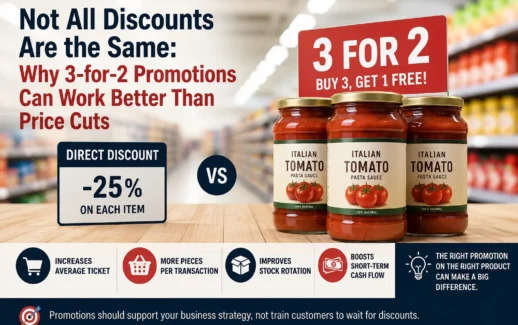
Not all promotions work in the same way.
A direct price reduction and a “3 for 2” promotion may appear similar mathematically, but commercially they can have very different effects.
A “3 for 2” offer can:
- increase basket size
- improve stock rotation
- accelerate cash flow
- encourage larger purchases
- protect perceived value better than constant price cuts
Discounts should create opportunity and support a strategy — not become the normal condition of the business.
Discounts Should Support a Strategy — Not Replace One
Discounts can be extremely useful when used strategically.
They can:
- Improve stock rotation
- Increase cash flow
- Support marketing activities
- Reduce slow-moving stock
- Attract customers strategically
However, promotions should never become the only solution to operational or commercial problems.
Used badly, discounts can:
- destroy margin
- weaken profitability
- reduce perceived value
- train customers to wait for promotions
- create long-term dependence on discounting
The objective of a promotion should not simply be increasing sales volume.
It should improve the overall performance and sustainability of the business.
Because increasing sales is not always the same as increasing profit.
Want to Understand How Your Retail Business Is Really Performing?
Take the free Retail Business Self-Assessment and discover how your business performs across:
– sales
– stock management
– marketing
– customer experience
– financial control
– operations